

Whether you are specifying a new generator set for an offshore platform, a land-based power station, or a marine vessel, the fuel system at the heart of your Cat® diesel engine affects long-term reliability, efficiency, and total cost of ownership.
This article breaks down the four main Cat diesel fuel system types — MUI, MEUI, HEUI, and Common Rail — and explains what differentiates them, why it matters in demanding industrial environments, and how Cat ACERT ™ technology further improves the efficiency.
The diesel fuel system does one job: deliver the precise quantity of fuel to each cylinder at exactly the right moment, under all load conditions.
In modern high-compression diesel engines, this requires injection at very high pressures and timing tolerances measured in milliseconds. Inefficient on either count and the consequences are immediate — reduced power output, higher emissions, accelerated component wear, and unplanned downtime.
Unplanned downtime is not just a cost issue; it is often a safety and compliance issue.
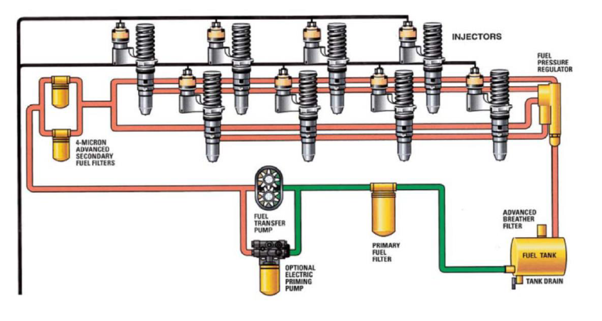
Schematic of a basic diesel fuel system. From Diesel Fuels and Fuel Systems, Application & Installation Guide (LEBW4976-12)
The MUI system is the foundational architecture. It uses the engine camshaft and push rods to generate injection pressure, and a mechanical linkage system to regulate fuel quantity in response to load variations.
The governor connects directly to the fuel rack, which adjusts fuel delivery in proportion to engine demand.
The MEUI (formerly known as Electronic Unit Injectors, or EUI) retains the mechanical actuation of the MUI (camshaft and push rods still generate injection pressure) but replaces the mechanical control linkage with an Electronic Control Module (ECM).
A solenoid on each injector receives voltage signals from the ECM. Fuel injection only occurs while the solenoid is energised. The ECM governs both injection timing and fuel quantity by precisely varying the duration and timing of those voltage signals.
The HEUI system takes a fundamentally different approach to generating injection pressure. Rather than relying on the camshaft, a dedicated hydraulic pump driven by the engine uses high-pressure engine oil to actuate the injectors. An ECM controls both the hydraulic pressure and the amount of fuel injected.
One of the most operationally significant features of the HEUI system is that it requires no mechanical adjustment. Performance changes are implemented entirely through software updates to the ECM.
The Common Rail system represents the most advanced fuel injection architecture in the Cat diesel range. Unlike MEUI and HEUI, injection pressure in a Common Rail system is not generated within the injector itself. Instead, a dedicated high-pressure fuel pump, driven off the engine, pressurises a fuel rail (manifold) that runs along both sides of the engine.
This pressurised rail delivers high-pressure fuel continuously to electronically controlled injectors at each cylinder, which manage both the timing and delivery of each injection event. Critically, the Common Rail system supports multiple injection events per combustion cycle, thus enabling more precise combustion management, lower noise signatures, and reduced emissions.
Thermal management is a key operational consideration. The Common Rail system does not circulate fuel continuously through the system the way unit injector systems do. High rail pressures generate more heat in the fuel, which can reduce viscosity and film strength. Overheated fuel with insufficient viscosity significantly increases injector and pump wear, particularly when fuel contains even trace contaminants.
Recommended practice is to install a fuel cooler to maintain inlet fuel temperature within the engine model's specified range. Filtration standards on Common Rail engines must be rigorously maintained.
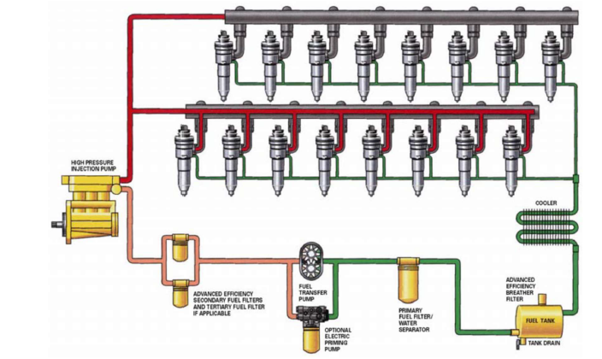
Schematic of a common rail diesel fuel system. From Diesel Fuels and Fuel Systems, Application & Installation Guide (LEBW4976-12)
Cat ACERT™ is a technology improves diesel engine performance by providing precise control over a range of combustion variables, which are regulated to produce higher performance with fewer emissions. It is designed to work across MEUI, HEUI, and Common Rail fuel systems, delivering measurable gains in both efficiency and output.
A study on Cat Tier 4 Interim and Stage IIIB engines shows up to 5% improvement in fuel consumption as the integrated design boosts power and performance. On the emissions front, the results are significant: up to 90% reduction in particulate matter and 50% reduction in NOx.
Built around design commonality and simplicity, Cat ACERT™ keeps engine uptime high and reduces the cost burden of service and maintenance over the engine's life. Its modular aftertreatment architecture means that transitioning from Tier 4 Interim to Tier 4 Final or Stage IV requires no additional space, making the upgrade path straightforward for Cat engine owners.
The result is a technology that simultaneously reduces emissions while improving fuel economy and overall performance.
It is important to note that Cat ACERT™ is not standard across the entire Cat engine lineup.
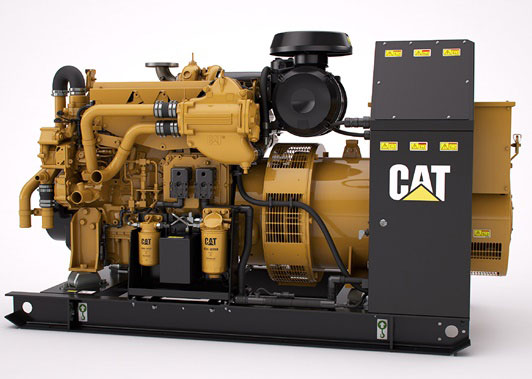
Cat C7.1 Marine Genset with Common Rail & ACERT technologies
Knowing how the different Cat fuel systems work helps you gain a better understanding of your engine. Combined with Cat ACERT™, you can expect better emissions performance and efficiency for your application.
| Fuel Systems | General Architecture | Key Differentiator |
| MUI — Mechanically Actuated and Controlled Unit Injectors | Camshaft and push rods generate injection pressure; mechanical linkage regulates fuel quantity; governor connects directly to the fuel rack. | Fully mechanical system with no electronic control; fuel delivery adjusts in direct proportion to engine load demand. |
| MEUI — Mechanically Actuated, Electronically Controlled Unit Injectors | Retains camshaft and push rod actuation from MUI, but replaces mechanical control linkage with an ECM; each injector receives voltage signals from ECM. | Electronic control over injection timing and fuel quantity via precisely varied voltage signal duration; combines mechanical pressure generation with electronic precision. |
|
HEUI — Hydraulically Actuated, Electronically Controlled Unit Injectors |
Dedicated hydraulic pump uses high-pressure engine oil to actuate injectors instead of the camshaft; ECM controls both hydraulic pressure and fuel quantity. | No mechanical adjustment required; all performance changes are implemented through ECM software updates alone. |
| Common Rail — High-Pressure External Injection | Dedicated high-pressure fuel pump pressurises a continuous fuel rail running along the engine; electronically controlled injectors at each cylinder manage timing and delivery. | Supports multiple injection events per combustion cycle for more precise combustion; fuel cooler and strict filtration standards required due to heat build-up at high rail pressures. |
| Cat ACERT™ — Advanced Combustion Emissions Reduction Technology | Not a standalone fuel system; works across MEUI, HEUI, and Common Rail systems by providing precise electronic control over a range of combustion variables | Delivers up to 5% fuel consumption improvement, 90% reduction in particulate matter, and 50% reduction in NOx; reduces emissions while improving fuel economy and performance. |
For technical inquiries or to discuss power generation specifications for your application, contact our Power & Energy team or see our range of Cat engines here.


